
CHEESE Electrostatics: Moving Beyond DFT in Drug Discovery
How our electrostatic similarity engine achieves 0.98 DFT correlation while searching billions of molecules in sub-second time.
Why Electrostatics Matter in Drug Discovery
Molecular recognition in biological systems is fundamentally driven by electrostatic complementarity. When a small molecule binds to a protein target, the electrostatic potential (ESP) surface of the ligand must complement the binding site. Traditional 2D fingerprint methods miss this critical dimension entirely, reducing complex 3D interactions to flat structural hashes.
At Deep MedChem, we set out to solve this gap with CHEESE Electrostatics — a tool that captures the full 3D electrostatic character of molecules and makes it searchable across billion-scale chemical libraries.
The EGFR Case Study
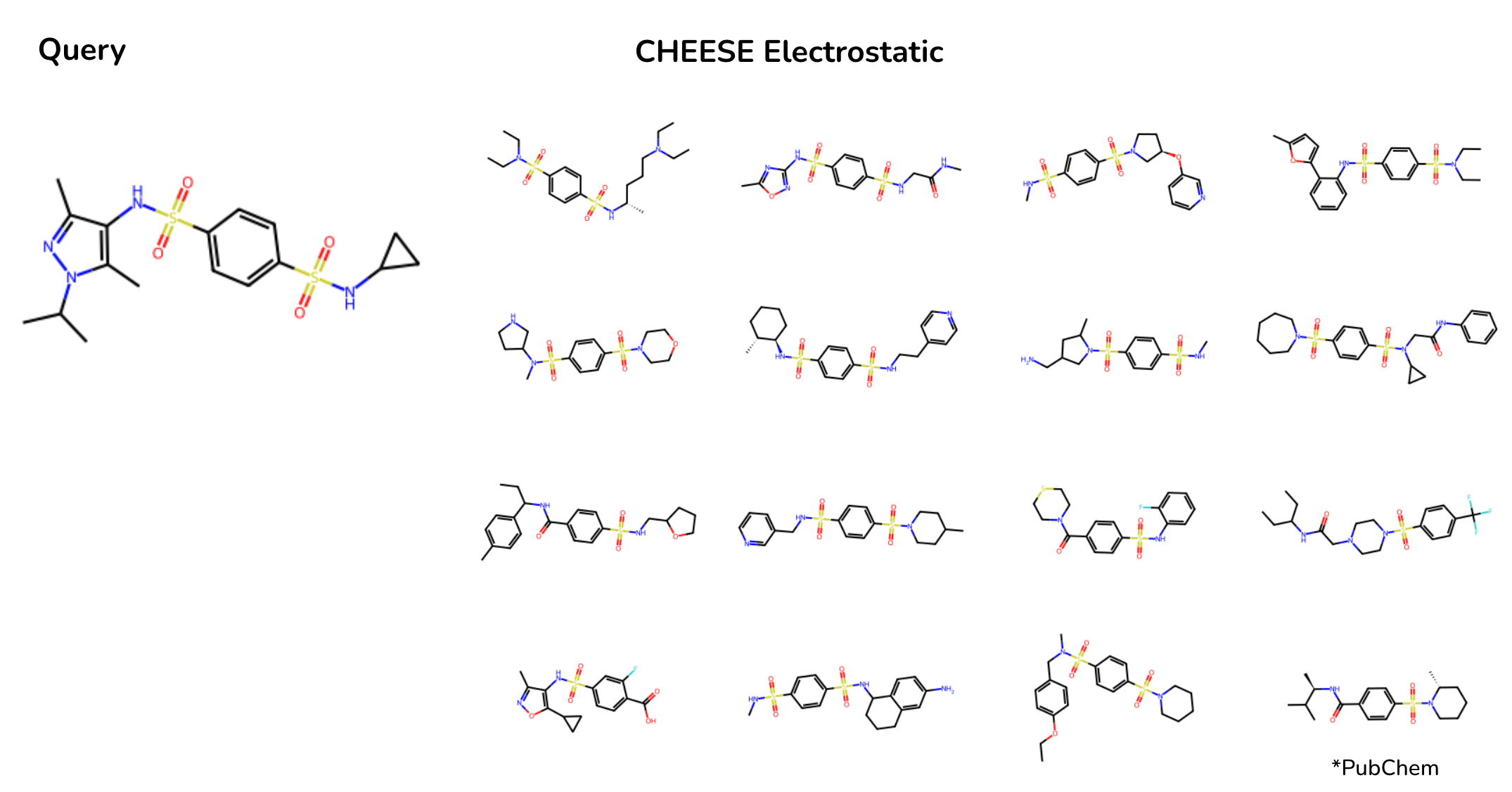
To validate our approach, we ran a comprehensive case study on the Epidermal Growth Factor Receptor (EGFR), a well-characterized kinase target with over 3,000 known inhibitors in ZINC15. We randomly selected 100 known EGFR inhibitors as queries and searched for electrostatically similar compounds.
- Searched 100 randomly selected EGFR inhibitors as queries
- Found at least one new inhibitor for 14 of the query compounds
- Discovered 5 novel inhibitors from a single query molecule
- Retrieved compounds shared high 3D shape and ESP similarity with known actives
"The ability to search by electrostatic similarity rather than just structural fingerprints opens up entirely new regions of chemical space — scaffolds that look different on paper but bind the same way."
Achieving 0.98 DFT Correlation
A key challenge in scaling electrostatic search is the computational cost of generating ESP surfaces. Density Functional Theory (DFT) calculations produce gold-standard electrostatic potentials but are prohibitively slow for billion-molecule databases. Our learned embeddings achieve a 0.98 correlation with DFT-computed ESP similarity while running orders of magnitude faster.
- Train neural network on DFT-computed ESP surfaces for 2M diverse molecules
- Distill ESP information into compact 256-dimensional embeddings
- Index embeddings for approximate nearest neighbor search
- Search 5.5B Enamine REAL molecules in sub-second time
What This Means for Your Pipeline
Whether you are looking for scaffold hops that preserve binding mode, exploring patent-free chemical space, or building focused libraries for a new target, CHEESE Electrostatics gives you a search dimension that 2D methods simply cannot provide.
CHEESE Platform Overview — Miton AI Talks
Watch on YouTube